

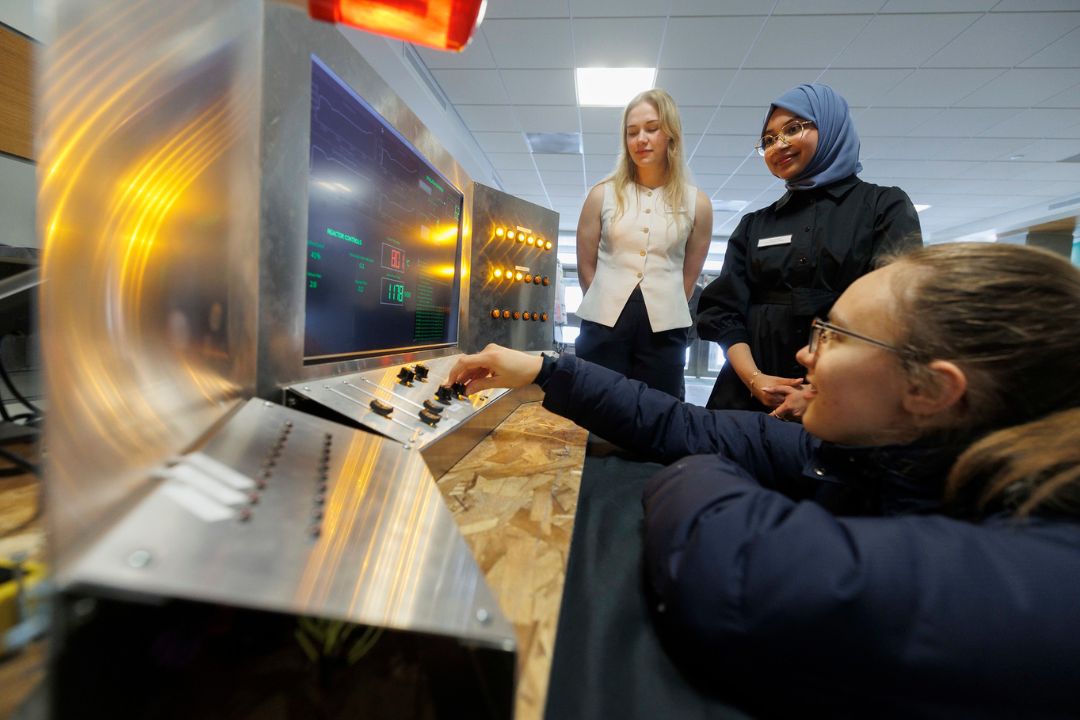
USask Engineering student design projects create industry and community impact
From a device that measures athletes’ shoe strikes to solutions that improve mining, teach youth about nuclear energy, to a complete structural design for a community powwow arbour, the University of Saskatchewan (USask) College of Engineering’s 2026 Capstone Design Showcase highlights the impact of engineering design and the future of the engineers the world needs.
By Engineering CommunicationsThe University of Saskatchewan (USask) College of Engineering recently hosted its annual Capstone Design Showcase, bringing together students, industry partners, alumni, faculty and community members to showcase and celebrate the achievements of final-year engineering students.
The showcase featured the top 14 capstone projects that address real-world challenges across the college’s 8 disciplines, including the general engineering capstone class, which includes multi-disciplinary teams. The projects reflect the breadth and impact of the engineering profession.
The Capstone Design Showcase marks the culmination of students’ undergraduate experience. Through capstone design courses, students apply the technical knowledge, teamwork and problem-solving skills they have developed throughout their degrees. Working alongside industry partners and faculty mentors, they deliver practical solutions with real-world relevance.
Capstone projects often create pathways to future opportunities, including employment, continued research, and student-led ventures in entrepreneurship and commercialization.
The annual showcase highlights the strength of USask Engineering students and their ability to address complex challenges. Through their work, students demonstrate their readiness to contribute as the engineers the world needs.
View all photographs from the evening on the College of Engineering's Flickr page: https://flic.kr/s/aHBqjCPwK1

The Top 14 Capstone Design Teams
The 14 groups are chosen from allocations across the eight engineering disciplines and the general engineering capstone classes. Faculty and peers select each winning team during the discipline capstone design showcase nights to move forward to the Capstone Design Showcase.
Mechanical Engineering
- Quick-Detection Dog Nail Trimmer: Alex Hofer, Rylan Galey, Kyle Parker and Robby Stewart
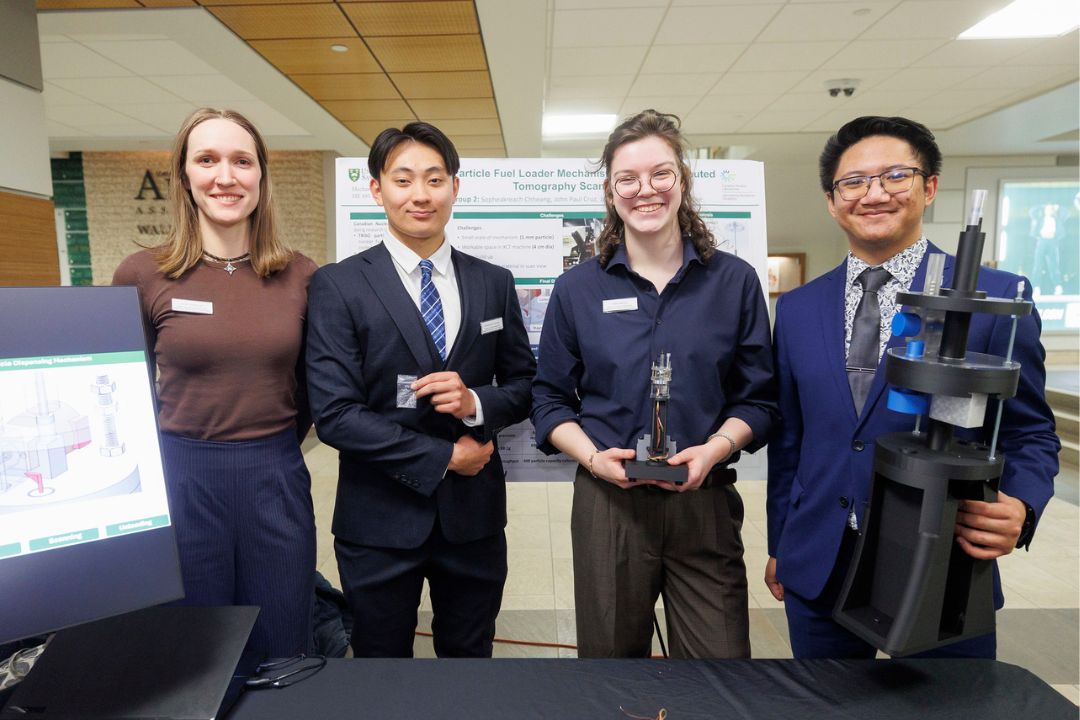
- Design of a TRISO Particle Fuel Dispensing Mechanism in an X-ray Computed Tomography (XCT) Setup: Maeve McKee, Sopheakreach Chheang, John Paul Cruz and Jayden Peregoodoff
- Magnetic Yard Sweeper: Max Kazuska, Conner Majic, Luke Schlosser and Sidney Sidloski
Civil Engineering
- Little Red Powwow Arbour: Lydia Menshenfriend, Vika Panchuk, Cole Otterson, Evan DeBack and Tong Tong
- Circle Drive over Idylwyld Drive Overpass Replacement: Brennan Praski, Thomas Kent, Evan Schneider, Jacob McHarg and Angel Rei Dalisay
Geological Engineering
- Evaluating Seam Separation in Potash Solution Mining: Griffin Dauk, Ayden Kavalench, Mila Szautner and Clay Highmoor
Environmental Engineering
- Lagoon Capacity Assessment and Conceptual Upgrade Study: Abuena Adaka, Raenna Hesje, Betsy Ugolo, Mario Gonzalez and Ashton Shashank
Electrical Engineering
- Grid Forming Inverter Control: Jacob Viher, Carter Warman, David Mielke and Kelvin Jonasson
Computer Engineering
- Reaction Chamber for Pathogen Detection in Crops: Matthew Hahn, Kylen Morris, Dawson Puderak and Liv Stianson
Chemical Engineering
- Quantifying GHG Emissions Intensity for Municipal Solid Waste Disposal in Saskatchewan: Aaron Shaw, Mitchel Van Kessel and Shawn Croke
- Separation of Potash Tailings: Jael Dilsner, Zach Pardoski and Andrea Stickwood
Engineering Physics
- Nuclear Reactor Simulator: Graham Elder, Eilidh Hlady, Sarah Khalid, Adrienne Kolkman and Daniel Okerstrom
General Engineering
- WatchOut!: Reducing Grader-Manhole Collisions During Snow Clearing: Ashton Bourgeois, Taha Kaleem, Rylee Moody and Brennan Yim
- Lektern - Footstrike Analysis: Jacob Marks, Alexander Webster, Oren Rotaru, Jeevan Prakash and Alvan Alam
Winners of the 2026 Capstone Design Showcase
Best Industry Award presented by the Association of Professional Engineers and Geoscientists of Saskatchewan (APEGS)
These awards will go to the top two capstone groups that developed a large-scale industrial design and scored on technical merit, persuasiveness of the design, potential impact and innovation.
- Winner ($1,000): Design of a TRISO Particle Fuel Dispensing Mechanism in an X-ray Computed Tomography (XCT) Setup: Maeve McKee, Sopheakreach Chheang, John Paul Cruz and Jayden Peregoodoff
- Runner-up ($500): Grid Forming Inverter Control: Jacob Viher, Carter Warman, David Mielke and Kelvin Jonasson
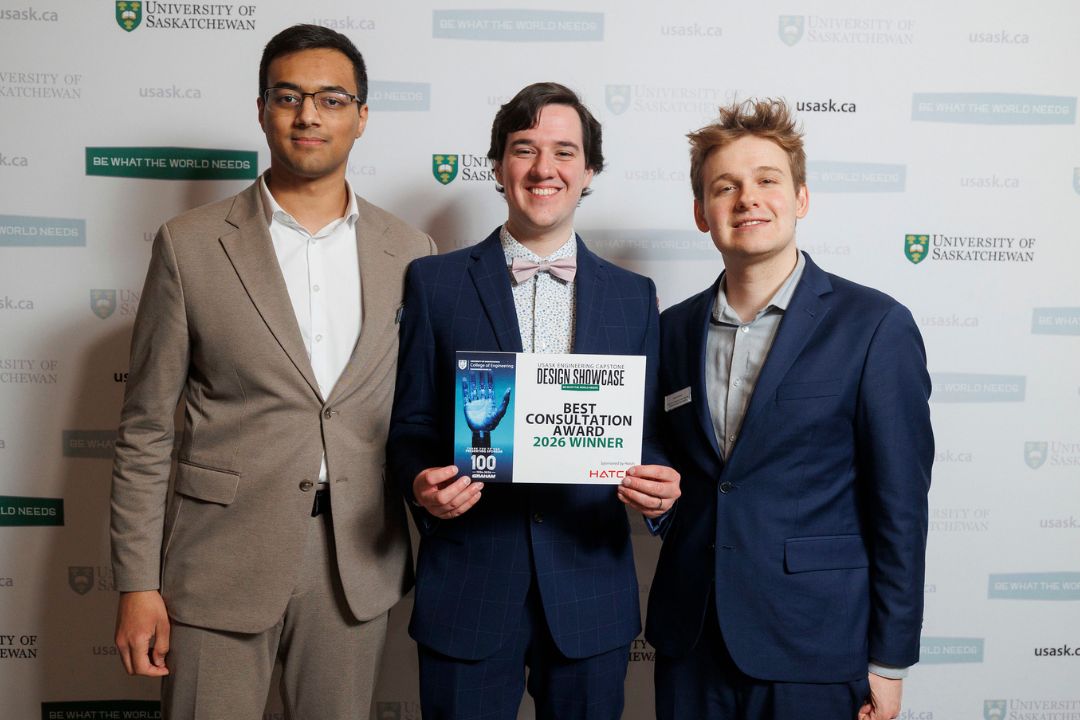
Best Consulting Award presented by Hatch
This award will go to the group that worked collaboratively with clients and other stakeholders throughout the design process. In this context, a collaborative design process involves consulting with all relevant stakeholders to develop a deep understanding of the problem (including any relevant social, cultural, environmental, or economic considerations), then working with the stakeholders to identify, evaluate, and implement solutions that address the problem holistically.
- Winner ($1,000): WatchOut!: Reducing Grader-Manhole Collisions During Snow Clearing: Ashton Bourgeois, Taha Kaleem, Rylee Moody and Brennan Yim
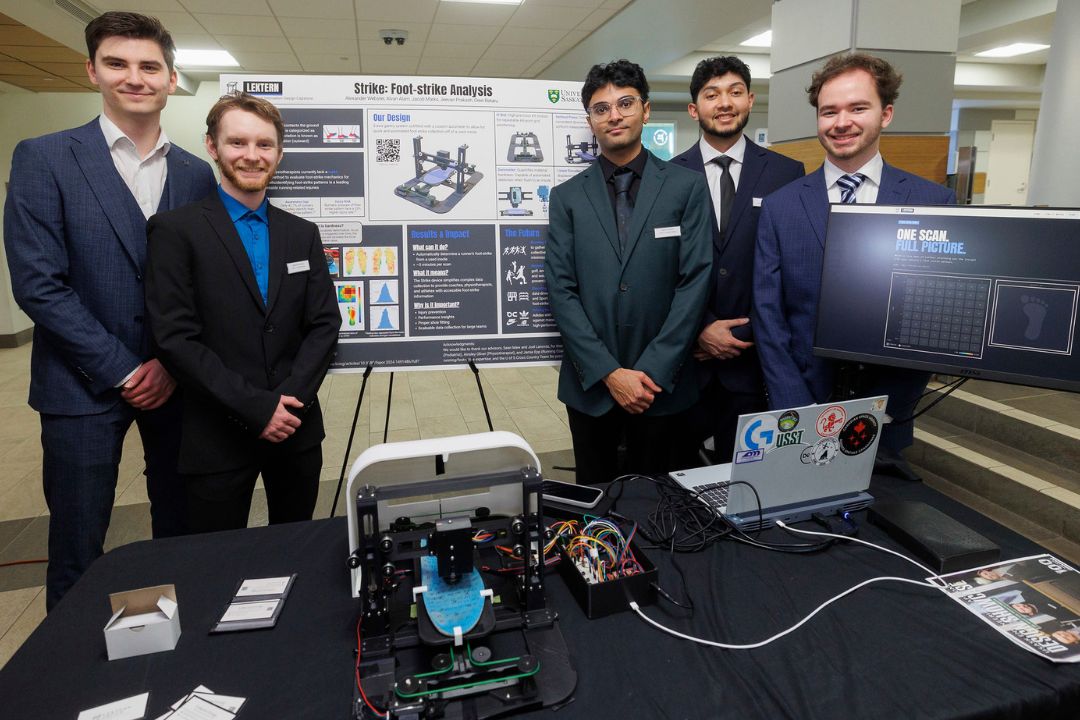
Best Product Award presented by the Saskatoon Engineering Society
These awards will go to the top two capstone groups that developed a product design and scored on technical merit, persuasiveness of the design, potential impact and innovation.
- Winner ($1,000): Lektern - Footstrike Analysis: Jacob Marks, Alexander Webster, Oren Rotaru, Jeevan Prakash and Alvan Alam
- Runner-up ($500): Quick-Detection Dog Nail Trimmer: Alex Hofer, Rylan Galey, Kyle Parker and Robby Stewart
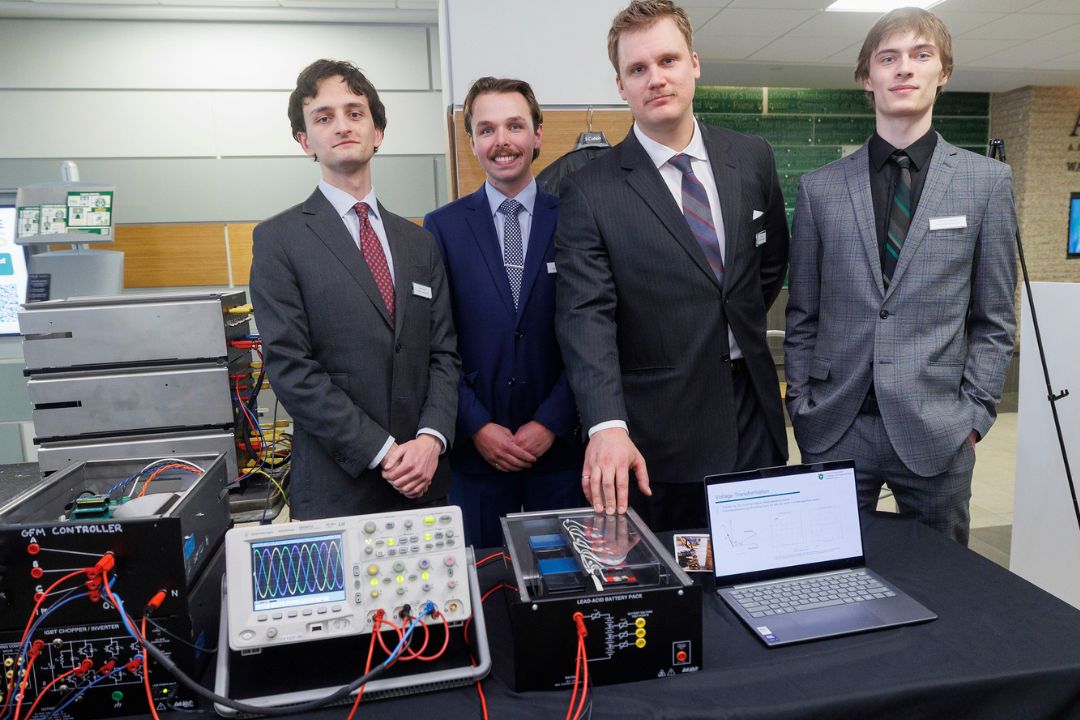
Environmental Impact Award presented by PINTER & Associates
This award will go to the group with the design that the judges feel is most capable of having the most positive environmental impact and the ability to help preserve, the certainty of impact, and/or remediate the natural environment.
- Winner ($1,000): Grid Forming Inverter Control: Jacob Viher, Carter Warman, David Mielke and Kelvin Jonasson
Social Impact Award presented by PCL
This award will go to the group with the design that the judges feel is most capable of having the most positive social impact, the certainty of impact, and the ability to help people.
- Winner ($1,000): Quick-Detection Dog Nail Trimmer: Alex Hofer, Rylan Galey, Kyle Parker and Robby Stewart
Audience Choice Award presented by the alumni and friends of the Engineering Advancement Trust (EAT)
This award will go to the group that the audience feels is most deserving.
- Winner ($1,000): Grid Forming Inverter Control: Jacob Viher, Carter Warman, David Mielke and Kelvin Jonasson
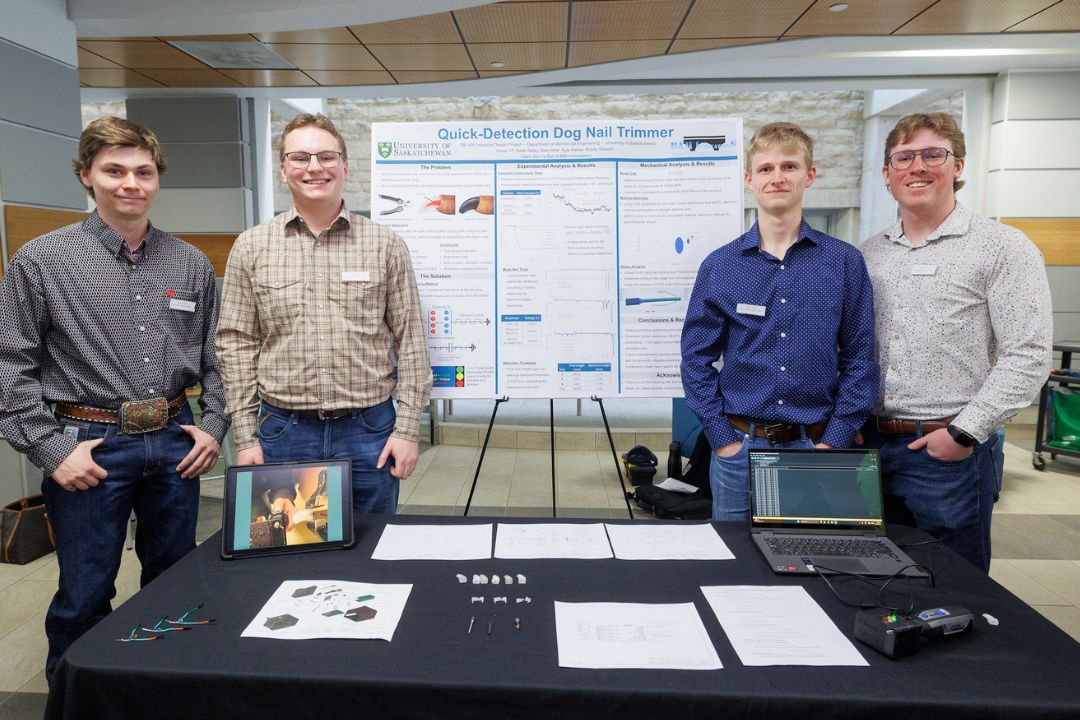
Social Impact Award presented by PCL
This award will go to the group with the design that the judges feel is most capable of having the most positive social impact, the certainty of impact, and the ability to help people.
- Winner ($1,000): Quick-Detection Dog Nail Trimmer: Alex Hofer, Rylan Galey, Kyle Parker and Robby Stewart
Audience Choice Award presented by the alumni and friends of the Engineering Advancement Trust (EAT)
This award will go to the group that the audience feels is most deserving.
- Winner ($1,000): Grid Forming Inverter Control: Jacob Viher, Carter Warman, David Mielke and Kelvin Jonasson